Polyvagal Theory, the Vagus Nerve and Boarding School Trauma
Polyvagal Theory, the Vagus Nerve and Boarding School Trauma
Many of us who went to boarding school learned to survive by disconnecting.
We learned to suppress.
- To keep going.
- To not need.
- To not feel.
- To not show too much emotion.
At the time, this may have been adaptive. It may even have helped us survive.
But years later, the nervous system can still be living as if we are back in that environment.
This is where polyvagal theory can be very helpful.
What Is the Vagus Nerve?
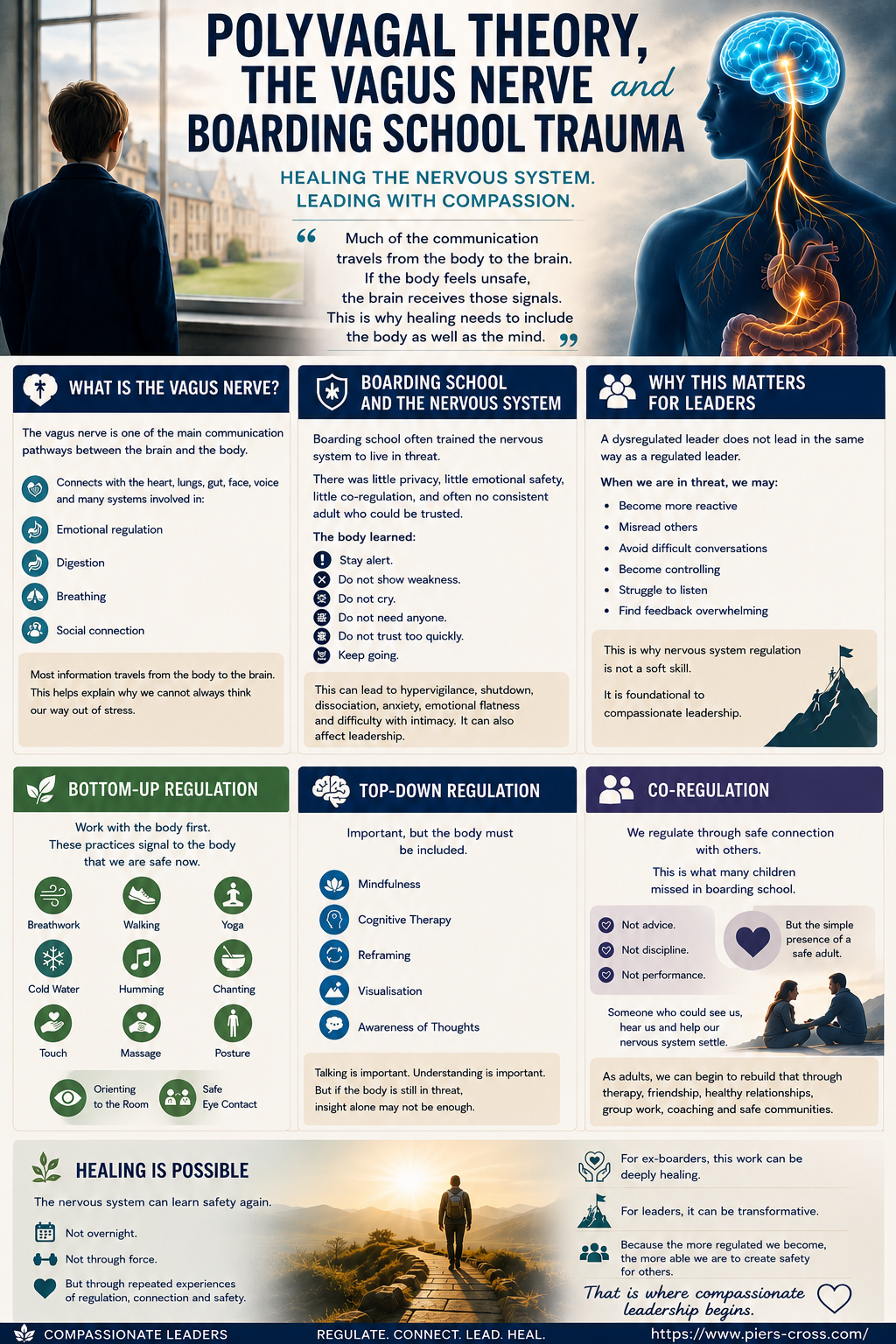
The vagus nerve is one of the main communication pathways between the brain and the body.
It connects with the heart, lungs, gut, face, voice and many of the systems involved in emotional regulation, digestion, breathing and social connection.
One of the most important things to understand is that much of the information travels from the body to the brain.
This helps explain why we cannot always think our way out of stress.
If the body feels unsafe, the brain receives those signals.
This is why trauma healing often needs to be body-based as well as cognitive.
Boarding School and the Nervous System
Boarding school often trained the nervous system to live in threat.
For many ex-boarders, there was little privacy, little emotional safety, little co-regulation, and often no consistent adult who could be trusted.
The body learned:
- Stay alert.
- Do not show weakness.
- Do not cry.
- Do not need anyone.
- Do not trust too quickly.
- Keep going.
This can lead to hypervigilance, shutdown, dissociation, anxiety, emotional flatness and difficulty with intimacy.
It can also affect leadership.
Why This Matters for Leaders
A dysregulated leader does not lead in the same way as a regulated leader.
When we are in threat, we become more reactive.
- We may misread others.
- We may avoid difficult conversations.
- We may become controlling.
- We may struggle to listen.
- We may find feedback overwhelming.
This is why nervous system regulation is not a soft skill.
It is foundational to compassionate leadership.
Bottom-Up Regulation
Polyvagal theory helps us understand the importance of bottom-up regulation.
This means working with the body first.
Some examples include:
- Breathwork.
- Walking.
- Yoga.
- Cold water.
- Humming.
- Chanting.
- Touch.
- Massage.
- Posture.
- Orienting to the room.
- Safe eye contact.
These practices can help signal to the body that we are safe now.
Top-Down Regulation
Top-down regulation is also important.
This includes mindfulness, cognitive therapy, reframing, visualisation and becoming aware of our thoughts.
But for many trauma survivors, the body must be included.
Talking is important.
Understanding is important.
But if the body is still in threat, insight alone may not be enough.
Co-Regulation
The third piece is co-regulation.
We regulate through safe connection with others.
This is what many children missed in boarding school.
Not advice.
Not discipline.
Not performance.
But the simple presence of a safe adult.
Someone who could see us, hear us and help our nervous system settle.
As adults, we can begin to rebuild that through therapy, friendship, healthy relationships, group work, coaching and safe communities.
Healing Is Possible
The nervous system can learn safety again.
Not overnight.
Not through force.
But through repeated experiences of regulation, connection and safety.
For ex-boarders, this work can be deeply healing.
And for leaders, it can be transformative.
Because the more regulated we become, the more able we are to create safety for others.
That is where compassionate leadership begins.