
Girls & Boarding School Trauma: Neglect, Attachment & “Almost Boys” (Episode 88)
Girls & Boarding School Trauma:
Neglect, Attachment & “Almost Boys”
Morag Edwards (Episode 88) AEM #88
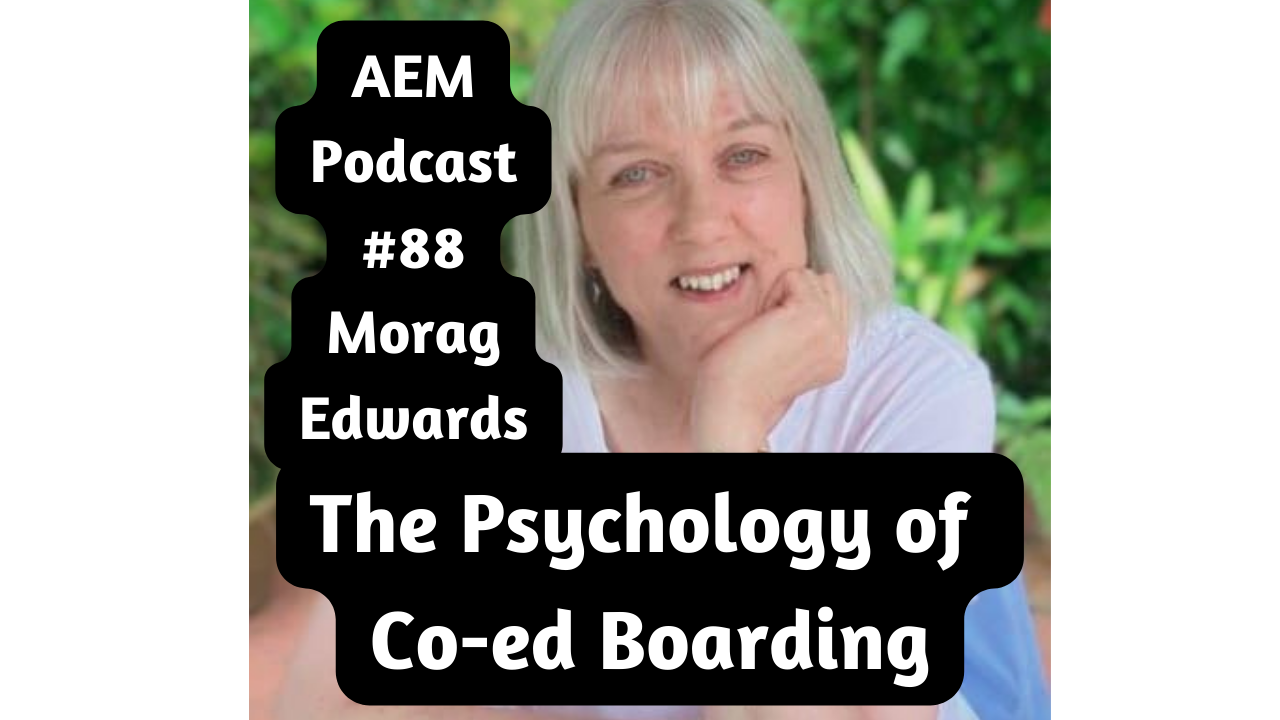
What happens when girls are placed into boarding schools designed for boys, by boys, and around boys — and then left largely unsupervised?
In Episode 88 of An Evolving Man Podcast, I speak with Morag Edwards, an educational psychologist of over 30 years and the bestselling author of Almost Boys (published under her pen name Isabel Ross).
Her book is one of the most important contributions to the conversation about boarding school trauma in girls, particularly within co-educational boarding schools.
This episode is essential listening for anyone interested in:
- boarding school syndrome
- neglect as developmental trauma
- attachment theory and early separation
- girls’ emotional safety in elite education
- and why “co-ed” does not automatically mean “healthy”
👉
Listen to Episode 88 here
👉
Explore more boarding school trauma resources
Why this episode matters
Much of the literature on boarding school trauma has focused — understandably — on boys.
But Morag’s work asks a crucial and often ignored question:
What about the girls?
In Almost Boys, and in this conversation, Morag makes clear that girls in co-educational boarding schools were not admitted for their education or wellbeing — but largely to civilise boys.
The result?
- intense academic pressure
- sexualised environments
- emotional neglect
- patriarchal norms
- and a profound absence of safeguarding
Morag Edwards: educational psychology meets lived experience
Morag trained as an educational psychologist after studying psychology at St Andrews University, following an early fascination with how minds work. For decades, she supported children and families professionally — without ever making the connection between her own struggles and her boarding school upbringing.
That connection only emerged much later, during lockdown, when Morag reread her childhood diaries.
What she saw stunned her:
- attachment disruption
- executive function stress
- emotional dysregulation
- trauma responses — all there on the page
This is a recurring theme in boarding school survivors:
- we carry the evidence with us
- but shame and embarrassment stop us looking
- until one day, the pattern becomes undeniable
“Almost boys”: girls in a patriarchal boarding system
Morag attended a co-educational boarding school where:
- there were 800 pupils
- 400 boarders
- and just 40 girl boarders
That ratio alone tells a story.
The girls were:
- told they were “lucky” and “privileged”
- expected to be academically outstanding
- pressured to be attractive, accommodating, and sexually available
- mocked if they outperformed boys
- emotionally unsupported and unsupervised
Morag describes a culture where girls existed for boys’ benefit — not for their own development.
This mirrors what many women report:
- femininity was suppressed
- compliance rewarded
- boundaries blurred
- and vulnerability exploited
Neglect: the trauma no one wants to name
One of the most powerful threads in this episode is neglect.
Morag describes long stretches where:
- no adult knew where the girls were
- no one checked emotional wellbeing
- weekends passed with minimal supervision
- entire boarding houses were left to a single, overwhelmed matron
This fits squarely with modern definitions of neglect, including those used by the NSPCC:
- emotional neglect
- lack of supervision
- failure to protect from harm
- absence of safe attachment figures
As you note in the conversation, research increasingly shows that neglect can be as damaging — or more damaging — than overt abuse.
Neglect leaves no obvious scars.
But it reshapes the nervous system.
Attachment theory: what boarding school disrupts
Morag brings clarity by grounding this conversation in attachment theory.
She explains the three foundations of secure attachment:
- Mentalisation – being held in mind
- Containment – co-regulation of big emotions
- Reciprocity – attuned communication
Boarding school disrupts all three.
Children lose:
- their attachment hierarchy overnight
- their primary regulators
- their emotional mirrors
- and the adults who know them best
Morag draws on Bowlby’s work:
- protest
- despair
- detachment
This sequence mirrors grief — because that’s what it is.
Why some children “thrive” (and why that’s misleading)
Morag offers a nuanced view of attachment styles in boarding schools:
- Securely attached children may appear to adapt — often by masking
- Anxious-ambivalent children are most at risk: bullied, overwhelmed, crushed
- Avoidant children “fit in” best — because emotional detachment is rewarded
But none of this equals wellbeing.
What schools often label as “settling in” is actually:
emotional shutdown
And masking, as Morag notes, is exhausting.
Girls, coercive control, and sexual bullying
One of the most disturbing sections of the episode concerns coercive control.
Morag recounts being targeted by an older boy she calls “the Fisherman”:
- exclusion
- humiliation
- manipulation
- and eventual sexual coercion
Crucially:
- she did not tell staff
- she did not trust adults
- she could not tell her sister, who was Head Girl
The system made disclosure impossible.
As we both note:
speaking up in boarding schools often makes things worse — not better
Silence, shame, and self-blame
Like many survivors, Morag internalised the bullying:
- “It must be me.”
- “I’ve failed again.”
- “My parents paid for this — I should be grateful.”
This is a devastating psychological bind:
- abandoned
- then blamed (implicitly or explicitly)
- then silenced
The result is deep shame — carried into adulthood.
Why this is not “just history”
A critical point Morag makes is that these dynamics still exist.
She cites:
- recent journalism
- contemporary survivor accounts
- unchanged power structures
She also highlights modern risks:
- traumatised boys absorbing extreme online misogyny
- lack of trauma-informed education
- schools unable (or unwilling) to monitor relationships closely
- children with no parental safety net at night
Without trauma-informed practice, the same harms repeat.
Key themes covered in Episode 88
This episode directly addresses topics people are searching for:
- girls boarding school trauma
- co-educational boarding schools
- neglect as childhood trauma
- attachment theory and boarding school
- emotional neglect in education
- sexual bullying in schools
- boarding school syndrome in women
- trauma-informed education
What Morag believes must change
Morag is clear:
- early boarding should be recognised as an Adverse Childhood Experience (ACE)
- boarding schools must be trauma-informed
- all staff (not just teachers) need safeguarding training
- emotional wellbeing must be central, not peripheral
And most importantly:
children must not be treated as “resilient by default”
Episode 88: what you’ll hear
- Why girls were admitted to co-ed boarding schools — and at what cost
- How neglect operates as trauma
- Why attachment disruption matters more than exam results
- The different ways children survive boarding school
- Sexual bullying and coercive control in unsupervised environments
- Why “settling in” often means emotional shutdown
- Why this conversation is urgent now
👉
Listen to Episode 88:
👉
Buy Morag’s book Almost Boys:
Final reflection
This episode challenges one of the most persistent myths in elite education:
that placing boys and girls together makes everything safer.
Without attachment, containment, and care, co-education can simply widen the field of harm.
Morag’s work is not anti-education.
It is pro-child.
And it demands that we finally listen to girls whose experiences have been minimised for generations.
FAQ
What is Almost Boys about?
A memoir-informed exploration of a girl’s experience in a co-educational boarding school, integrating attachment theory, neglect, and trauma.
Are co-educational boarding schools safer for girls?
Not automatically. Without trauma-informed safeguarding, girls may face sexual bullying, neglect, and emotional harm.
Why is neglect so damaging?
Neglect disrupts emotional regulation, attachment, and self-worth — often with lifelong consequences.
Can attachment styles change after boarding school?
Yes. The brain remains plastic, but healing usually requires relational safety and often therapeutic support.