
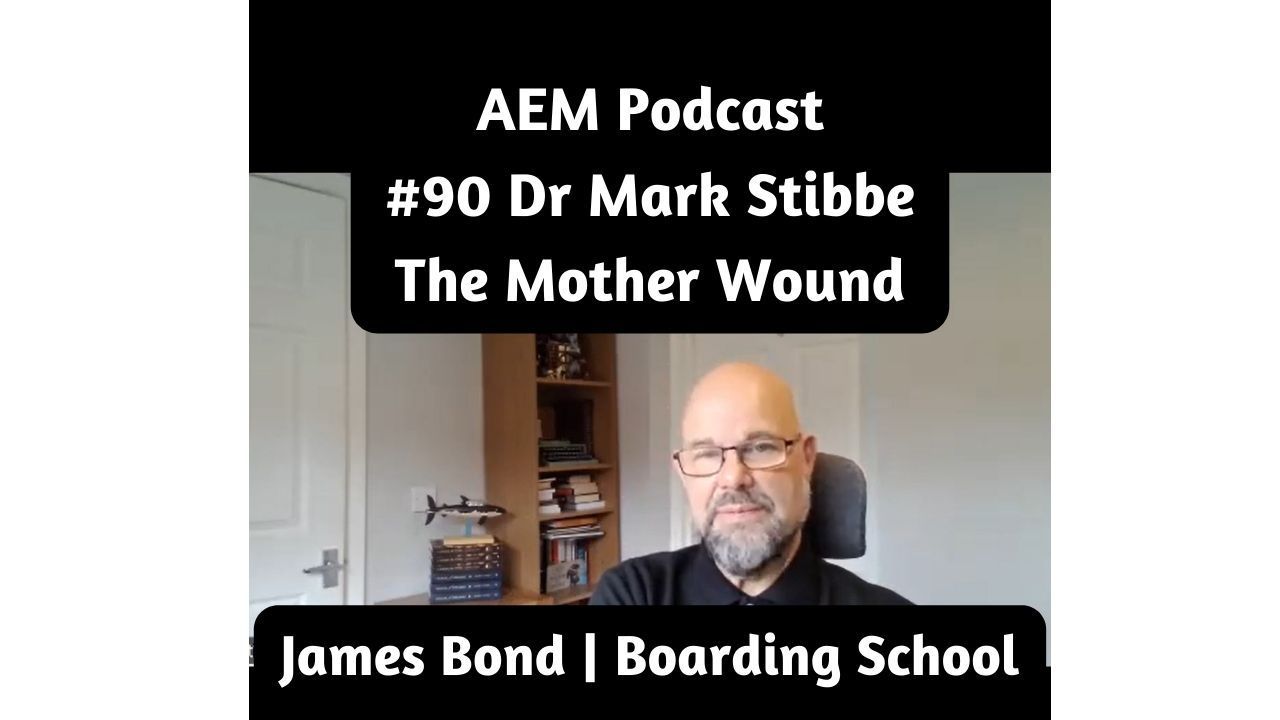
The Mother Wound, Boarding School Syndrome & Skyfall: What James Bond Reveals About Attachment |AEM #90 Dr Mark Stibbe
The Mother Wound, Boarding School Syndrome & Skyfall:
What James Bond Reveals About Attachment
AEM Podcast #90 with Dr Mark Stibbe PhD
There are conversations that land in the head… and conversations that land in the body.
This one did both.
In Episode #90 of An Evolving Man, I sat down again with Dr Mark Stibbe to explore something many of us circle for years before we can name it:
the mother wound — and how it connects with boarding school syndrome, emotional shutdown, intimacy, and the hidden grief many men (and women) carry.
What surprised me most was how naturally the discussion moved from early attachment and neuroscience… to British culture… and then to an unexpected place:
James Bond. Skyfall.
And the line that says everything many ex-boarders already know in their bones:
“Orphans make the best recruits.”
What is the “mother wound”?
Mark begins with a crucial tone-setting: this conversation isn’t here to blame or demonise mothers.
He draws on Donald Winnicott’s idea of the “good enough mother” — and makes a distinction I think matters deeply in Britain, where so many families still struggle to speak about emotion without shame.
He then describes mothering love as something profoundly practical and embodied — expressed through three core channels:
- Voice (affirmation, soothing, attunement)
- Eyes (being seen, warmth, presence)
- Touch (comfort, protection, appropriate closeness)
In other words: not just care, but felt safety.
And it’s hard to overstate this point: when a child misses these forms of connection, it’s not simply “unfortunate.” It can shape the blueprint of how they relate for decades.
Secure vs insecure attachment
Mark frames the mother wound through attachment:
Secure attachment can create:
- a stable sense of self-worth
- an inner sense of basic trust
- greater ease with closeness and relationship repair
Insecure attachment can form in different ways
Mark breaks insecure mothering patterns into three broad categories (and I found this clarity powerful):
- Absent mothering
- physically absent (death, abandonment, illness, addiction)
- or emotionally absent (present in the home, but not emotionally available)
- Ambivalent mothering
- inconsistent love / inconsistent presence
- a child learns: Which version of mum am I getting today?
- Abusive mothering
- verbal, emotional, physical, sexual, or spiritual abuse
And then he offers a line that’s worth sitting with:
Trauma isn’t only
what happened to you.
It can also be
what didn’t happen for you.
Boarding school as a second orphaning
This is where the boarding school conversation becomes unavoidable.
Mark shares his own story: separated early, then sent to prep school at eight — and describes boarding as a kind of “second orphaning.”
That phrase matters.
Because many ex-boarders speak as if they “shouldn’t” be affected:
- “It was a privilege.”
- “It gave me opportunities.”
- “It made me resilient.”
And yet, the nervous system often tells a different truth.
When a child is sent away young, they don’t just miss home. They often learn to survive by doing something very British:
- shut down.
- Switch off feelings.
- Endure.
- Perform competence.
Then… forget to turn the switch back on.
What Skyfall gets right about the British psyche
I didn’t expect a Bond film to become a psychological mirror — but Mark names something real.
In Skyfall, Bond’s relationship with “M” is essentially a mother dynamic: loyalty, betrayal, duty, abandonment, and the longing for care that can’t be spoken.
And that line — “Orphans make the best recruits” — lands like a thesis statement for the British imperial model:
- If you want someone who can survive isolation, suppress emotion, and do the job without tenderness…
- train them early.
- Cut off attachment.
- Replace home with institution.
- Replace feeling with duty.
This isn’t just about espionage.
It’s about leadership, relationships, parenting, and the emotional culture we pass down.
Common “mother wound” patterns in adult life
Mark speaks carefully here (and I appreciated that). He doesn’t claim a single narrative for everyone.
But he points to repeated patterns he’s observed, including:
- difficulties with trust and intimacy
- withdrawal from closeness, or obsessive attachment
- the tendency to recreate early blueprints in adult relationships
- coping strategies that become self-destructive over time
He also names something many people feel but rarely say out loud:
unprocessed grief can turn into contempt
— towards the feminine, towards vulnerability, towards the parts of us that still need mothering.
Healing the mother wound
The healing section is where this episode becomes more than analysis.
A few themes stand out:
1) Understanding changes everything
Mark references the idea (in essence): the more we understand the forces that shaped our parents, the more we can soften toward reality — without denying harm.
Not excusing. Not bypassing.
But seeing the whole picture.
2) Forgiveness is powerful — but not performative
He’s very clear that forgiveness can’t be a duty-driven performance. It has to land in the heart, not just the head.
And often it requires something deeper than logic: an emotional re-patterning.
3) Healing must involve the emotional brain
Mark makes a point I strongly agree with:
Insight alone isn’t always enough.
A lot of people understand their story intellectually — but their body is still living the old reality.
He speaks about needing change not just in the thinking brain, but in the limbic system: the felt sense of safety, connection, belonging.
In plain language: you can’t talk your way out of an attachment wound.
You have to experience a new kind of relationship and presence.
A final reflection
If you’re reading this and feeling something in your chest, stomach, throat, or eyes — that’s not weakness.
That’s your system recognising a truth.
The mother wound isn’t just personal.
It’s cultural.
And if we want a different Britain — safer children, healthier leadership, deeper intimacy, less shame — we will have to learn how to do what many of us never got taught:
- rupture and repair.
- truth and tenderness.
- feeling and connection.
Listen to the episode
AEM #90 — Dr Mark Stibbe: The Mother Wound | Boarding School Syndrome | James Bond | Skyfall
Recommended links / resources
- My previous conversation with Dr Mark Stibbe
- Book: Home at Last
- Book: A Book in Time
- Film: Skyfall
Call to action
If this resonates, I’d love to hear from you:
- What did you learn about love in your family system?
- What did boarding school teach you about vulnerability?
- What does repair look like for you today?
And if you want support working with the mother wound and boarding school syndrome in a grounded, trauma-informed way, you can explore my work here:
(Coaching /
Documentary /
Newsletter link)